The United Arab Emirates has developed a structured tax framework in recent years. Earlier decades carried almost no broad taxation across most sectors. Economic growth, global trade ties, and public infrastructure investment led authorities toward a balanced system that supports national development.
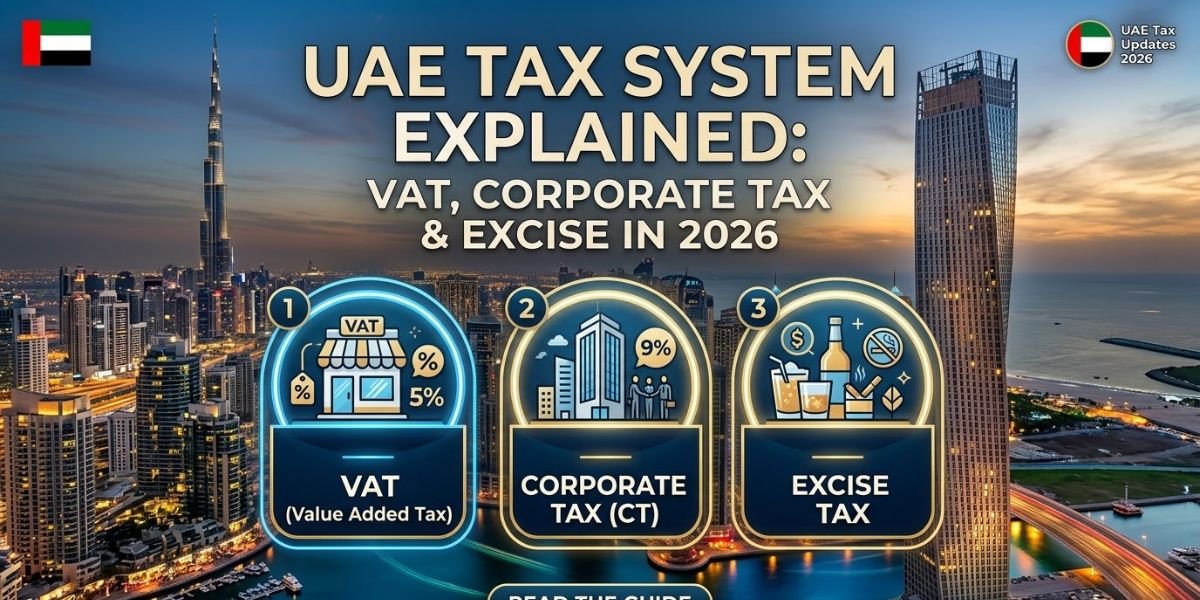
During 2026, three major pillars shape the UAE tax environment: Value Added Tax, Corporate Tax, and Excise Tax. Each operates with a distinct purpose and applies across different sectors of the economy. Business owners, investors, and entrepreneurs can benefit immensely if they develop a clear understanding of how these taxes function.
Value Added Tax, commonly called VAT, was introduced in the UAE in 2018 at a standard rate of 5% and is administered by the Federal Tax Authority. It applies across many goods and services that people purchase daily. The system collects tax gradually at each stage of production and distribution, thereby spreading responsibility across the supply chain.
Many residents still ask what VAT is in the UAE, especially when starting a business or reviewing invoices. VAT operates as a consumption tax paid by the final buyer, while businesses act as collectors that report tax payments.
Key Registration Details
Businesses with annual taxable revenue/Taxable Expenses exceeding AED 375,000 must register under VAT. Voluntary registration becomes available at AED 187,500. Registration grants a Tax Registration Number that appears on invoices/E-invoicing and tax filings. Registered entities receive a Tax Registration Number (TRN) and must issue proper invoices showing the tax amount.
VAT plays a vital role within the broader fiscal strategy. The system supports public infrastructure, economic programs, and regulatory oversight. Businesses also gain credibility through transparent financial records and compliant tax practices.
How Does VAT Work in the UAE?
The mechanism remains fairly straightforward. Businesses registered for VAT add a 5% charge to the price when selling taxable goods or services. That amount later goes toward government revenue.
Companies also pay VAT when purchasing supplies or services. This amount becomes input VAT. When tax returns are filed, businesses subtract input VAT paid earlier against VAT collected during sales. Only the difference gets transferred to the Federal Tax Authority. This structure prevents double taxation and keeps the system fair across industries.
In the UAE VAT system, some supplies are treated differently under tax regulations. Certain goods and services are zero-rated for VAT, while others are VAT-exempt. Examples include specific healthcare services, international transportation services, and residential property leases after the first supply.
Need professional help with VAT compliance? Our team at Innovex Tax consists of trusted excise tax compliance advisors and VAT consultants in Dubai, who help businesses understand registration rules, filing obligations, and reporting standards.
UAE Corporate Tax Explained for Businesses Operating in 2026
Corporate tax applies directly to the net profits of businesses operating here. The regime has run smoothly since its launch and shows no major rate shifts in 2026. Companies calculate taxable income from accounting records with specific adjustments for allowed deductions and nondeductible items.
Corporate Tax Rates and Thresholds
Corporate Tax applies to financial years beginning on or after 1 June 2023. This policy marked a major shift within the country’s fiscal structure, aligning the UAE with global financial standards while maintaining a business-friendly environment.
Corporate Tax applies to taxable income according to the following structure:
0% on taxable income up to AED 375,000
9% on taxable income above AED 375,000
This moderate structure supports startups and small enterprises while maintaining competitive conditions for international investors.
Corporate Tax Guidelines for the UAE in 2026
Businesses must follow updated guidelines issued by the Federal Tax Authority. These guidelines outline reporting standards, taxable income calculations, record-keeping requirements, and financial disclosure rules. Key regulatory expectations include:
Corporate Tax applies at 0 percent on taxable income up to AED 375,000, and 9 percent on taxable income above that threshold.
Companies must register with the Federal Tax Authority and obtain a Corporate Tax Registration Number.
Businesses are required to maintain financial records and supporting documents for at least seven years under UAE tax regulations.
Annual Corporate Tax returns must be submitted within 9 months after the end of the relevant financial year.
Free Zone businesses may receive a 0 percent rate on qualifying income if they meet regulatory conditions and maintain proper compliance.
Transfer pricing documentation must follow OECD principles when transactions occur between related parties.
Accurate financial statements must reflect taxable income calculations in accordance with UAE accounting standards.
Sole establishments (natural persons) in the UAE must register for Corporate Tax (CT) if their annual gross revenue from business activities exceeds AED 1 million in a Gregorian calendar year.
Corporate taxation encourages transparency and stronger governance across private companies. The policy strengthens the UAE’s reputation as a global financial center while supporting national revenue.
Innovex Tax offers compliant corporate tax services in Dubai designed for startups, SMEs, and established firms. Our experienced advisors assist with compliance, financial documentation, and reporting under UAE regulations to strengthen your company’s financial strategy.
What is the Excise Tax in the UAE?
Excise tax differs greatly compared with VAT or corporate tax. Instead of broad-based consumption or profit-based taxation, excise taxes target specific products that may affect public health or the environment.
Authorities introduced the Excise Tax system in 2017, and the rules are updated periodically to close loopholes and adapt to market trends. The Federal Tax Authority closely monitors how products are formulated and marketed to ensure they are correctly classified.
UAE Excise Tax Rules in 2026
The Excise tax rules in the UAE apply mainly to products in health-related categories. Tobacco products, electronic smoking devices, carbonated drinks, and energy beverages commonly fall under this policy. Excise tax rates vary widely depending on product classification. Some categories carry rates as high as 100% of the product value.
According to Cabinet Decision No. 52 of 2019, which outlines excise goods, tax rates, and the method used for calculating excise prices, the following excise tax rates apply:
Product Category
Excise Tax Rate
Carbonated beverages
50%
Tobacco products
100%
Energy drinks
100%
Electronic smoking devices
100%
Liquids used in electronic smoking devices and related tools
100%
Products with added sugar or other sweeteners
50%
Why the Excise Tax Exists
Governments often implement excise taxes as public health measures. Higher retail prices reduce the consumption of products linked with medical concerns. The UAE uses excise taxation not only for revenue generation but also to promote healthier consumer behavior.
Compliance Requirements for Excise Goods
Businesses dealing in excise goods must register with the Federal Tax Authority. Importers, producers, and warehouse operators must maintain detailed inventory records and submit periodic tax returns. According to the Excise tax rules for 2026 in the UAE, your products require clear product classification, accurate pricing documentation, and transparent reporting during supply chain transactions.
Final Thoughts
The UAE tax framework in 2026 reflects a carefully balanced system that supports economic growth while maintaining global financial credibility. VAT applies across everyday transactions, corporate tax addresses business profits, and excise tax targets select regulated goods. Staying informed is the first step, but taking action is what protects your business. The rules are complex, but you do not have to figure them out alone. Our team at Innovex Tax understands the intricacies of Emirati regulations and can tailor a compliance strategy that fits your unique business needs. We provide expert tax consulting services in the UAE, guiding companies through registration, reporting, and regulatory updates. Connect with our specialists who simplify complex tax responsibilities for growing businesses.


 Corporate tax applies directly to the net profits of businesses operating here. The regime has run smoothly since its launch and shows no major rate shifts in 2026. Companies calculate taxable income from accounting records with specific adjustments for allowed deductions and nondeductible items.