
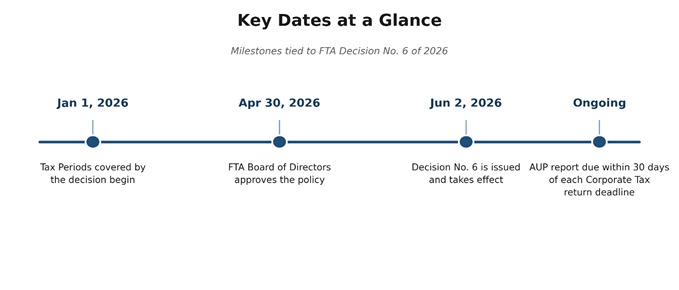
On June 2, 2026, the Federal Tax Authority issued Decision No. 6 of 2026. The decision lays out extra compliance steps for a specific group of businesses operating in UAE free zones: companies that qualify as Qualifying Free Zone Persons and that carry out the distribution of goods or materials in or from a Designated Zone. This activity is treated as a Qualifying Activity under existing corporate tax rules, and it comes with its own tax benefits. Because that benefit is valuable, the FTA wants a reliable way to confirm the business genuinely fits the description before that lower tax treatment applies.
The decision applies to Tax Periods that begin on or after January 1, 2026, so most companies will start feeling its effects in their upcoming tax filings rather than in periods that have already closed.
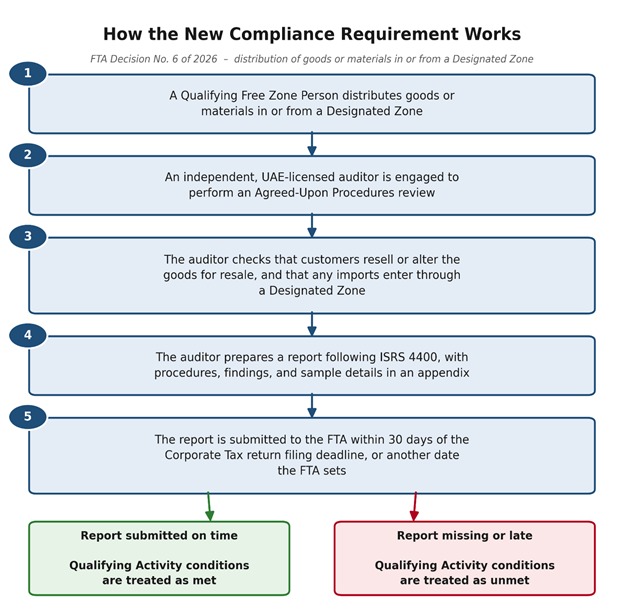
In short, the document sets up a new verification step. A company that wants its distribution activity to count as qualifying income under the corporate tax law now has to hire an independent auditor to check its records and produce a formal report confirming that the activity actually meets the legal definition. Without that report, the tax authority will not treat the company as having met the conditions, even if everything else about the business looks correct.
Decision No. 6 of 2026 does not stand on its own. It builds directly on several earlier pieces of legislation, and understanding those pieces helps explain why this new decision exists.
Legal Instrument | What It Establishes |
Federal Decree-Law No. 47 of 2022 (Corporate Tax Law) | Sets up the entire framework for taxing corporations and businesses in the UAE, including the special treatment given to free zone companies. |
Federal Decree-Law No. 28 of 2022 | Governs how tax rules are administered and enforced. |
Federal Decree-Law No. 13 of 2016 | Established the Federal Tax Authority itself. |
Cabinet Decision No. 100 of 2023 | Defines what counts as qualifying income for a Qualifying Free Zone Person. |
Ministerial Decision No. 84 of 2025 | Already required certain conditions to be met for corporate tax purposes and gave the FTA room to add further procedures. |
Ministerial Decision No. 229 of 2025 | Lists the distribution of goods or materials in or from a Designated Zone as a recognized Qualifying Activity. |
Table 1: The legal instruments behind Decision No. 6 of 2026
Decision No. 6 of 2026 was approved by the Federal Tax Authority Board of Directors at its 44th meeting, held on April 30, 2026, and it was signed off using the delegation of authority granted under Decision No. 9 of 2021, which allows the Vice Chairman of the Board to sign such decisions.
This decision matters to any company that meets two conditions at the same time. First, the company must already qualify as a Qualifying Free Zone Person under the corporate tax law, which generally means it operates in a free zone and meets a set of substance, income, and reporting requirements. Second, the company must carry out distribution of goods or materials in or from a Designated Zone, which is one of the recognized Qualifying Activities listed in Ministerial Decision No. 229 of 2025.
If a company fits both of those descriptions, it now has an added compliance obligation on top of everything it already had to do. Companies that do not engage in this particular distribution activity are not directly affected by this decision, though they remain subject to the other corporate tax rules that already apply to them.
The decision keeps its definitions section short. Rather than creating new terms, it simply says that words used in the decision carry the same meaning given to them in the Corporate Tax Law, Cabinet Decision No. 100 of 2023, and Ministerial Decision No. 229 of 2025, unless the surrounding text makes it clear that a different meaning is intended. This approach keeps the new decision consistent with the rules already in place, rather than introducing a separate vocabulary that businesses would need to learn.
Article 2 is where the substance of the decision really begins. It introduces a new obligation for any Qualifying Free Zone Person engaged in distributing goods or materials in or from a Designated Zone.
Companies that fall under this category must now obtain what is called an agreed-upon procedures report. This is a specific type of report produced by an independent auditor after the auditor carries out a defined set of checks on the company’s records and transactions. The report does not offer an opinion in the way a standard audit report does. Instead, it states plainly what procedures were carried out and what was found, leaving interpretation to the reader, which in this case is the Federal Tax Authority.
The auditor who prepares this report can be the same external auditor already responsible for the company’s annual financial statement audit, or it can be a different independent auditor, as long as that auditor is licensed to practice in the UAE.
The report needs to document the procedures performed and the results found for two separate points, summarized below.
Requirement | What Must Be Shown |
Reseller Status | The company supplies goods or materials to customers who resell them, or who process or alter them before selling them onward, in full or in part. |
Designated Zone Importation | Any goods or materials the company itself imports into the UAE come in through a Designated Zone, rather than an ordinary port of entry outside that zone. |
Table 2: The two-part test at the center of Article 2
Both points matter because they go to the heart of what makes this activity a Qualifying Activity in the first place. A company that supplies goods to end users rather than resellers, or that brings goods into the country outside a Designated Zone, would not be performing the activity the tax law intends to benefit.
The decision lists examples of documentation a company can rely on to support each part of the test. These are described as non-exhaustive examples, meaning other forms of proof can also work.
Category | Examples of Supporting Documentation |
Reseller Status | Valid business, trade, or commercial licenses held by the customer; signed customer declarations confirming the goods were bought for resale or for donation to a public benefit entity; sales agreements, invoices, and purchase orders showing a pattern of resale or onward supply. |
Designated Zone Importation | Import declarations and customs clearance paperwork showing lawful entry through a Designated Zone; shipping records, such as a bill of lading or an airway bill, that clearly show entry through a Designated Zone. |
Table 3: Supporting documentation for the two-part test
The report cannot be put together in whatever format the auditor prefers. It has to follow International Standard on Related Services 4400, commonly referred to as ISRS 4400, which is the standard issued by the International Auditing and Assurance Standards Board for agreed-upon procedures engagements. On top of that international standard, the auditor also has to follow any local legislation that governs auditing practice in the UAE. The report itself must describe both the procedures the auditor carried out and the factual results of those procedures, without adding subjective conclusions.
Once the report is ready, it has to reach the Federal Tax Authority within a set window. The deadline is thirty days after the deadline for filing the Corporate Tax return for the relevant Tax Period, unless the Authority sets a different date. This gives companies a short buffer after their tax return is due, rather than requiring the report to be submitted alongside the return itself.
The consequence for skipping this step is significant. If a Qualifying Free Zone Person fails to submit the agreed-upon procedures report on time, the conditions needed for the distribution activity to count as a Qualifying Activity will simply be treated as unmet. That means the company could lose the favorable tax treatment tied to that activity for the relevant Tax Period, even if the underlying business genuinely met every other requirement. The report, in other words, is not optional paperwork sitting on the side. It is treated as a condition for qualifying in the first place.
Article 3 gets into the mechanics. It spells out exactly which procedures the auditor is expected to carry out to support the two claims described in Article 2, and it explains how large a sample of records the auditor needs to review.
Three separate procedures are laid out for this part of the review, each pulling from the customers or agreements with the highest transaction values in the Tax Period.
Procedure | What the Auditor Checks |
Trade License Review | Confirms that the sampled customer trade, business, or commercial licenses list activities such as trading, wholesaling, retailing, distributing, or manufacturing, pointing toward reselling. |
Customer Declaration Review | Confirms that the sampled, signed, and dated customer declarations affirm the goods were bought for resale or for donation to a public benefit entity. |
Sales Agreement Review | Confirms that the sampled sales agreements, invoices, and transaction records show bulk quantities, resale conditions, or pricing structures consistent with onward sale or resale. |
Table 4: Procedures used to confirm reseller status
A separate set of three procedures applies to this second requirement, and it only matters for companies that import goods themselves.
Procedure | What the Auditor Checks |
Import Documentation Review | Confirms that the sampled customs declarations, import permits, sales contracts, and bills of lading show the goods entered the UAE through a Designated Zone. |
Designated Zone Status Confirmation | Confirms, with input from the relevant Free Zone Authority, that the named free zone, port, or area is officially recognized as a Designated Zone. |
Internal Records Review | Confirms that the sampled inventory logs, warehousing reports, and logistics documentation show the goods were received, handled, or stored inside a Designated Zone before distribution. |
Table 5: Procedures used to confirm Designated Zone importation
Rather than leaving sample size up to guesswork, the decision provides a formula. The company starts with its Sample Population, meaning the total number of relevant customers, sales agreements, or imports for the Tax Period, depending on which procedure is being applied. That number is plugged into a standard statistical sampling formula that also factors in a fixed Margin of Error. The result tells the auditor exactly how many records need to be pulled and reviewed.
Under each procedure, the decision also specifies that the Sample Size should be made up of the customers, sales agreements, or imports with the highest transaction values during the Tax Period. This means the auditor is not picking records at random, but instead focusing on the largest and most financially significant transactions first.
Term | Meaning |
Sample Population | The total number of relevant customers, sales agreements, or imports for the Tax Period, depending on the procedure being applied. |
Margin of Error | Fixed at ten percent for the purposes of this decision. |
Sample Size | The number of records the auditor must pull and review, calculated from the Sample Population and Margin of Error, drawn from the highest transaction values first. |
Table 6: Sample size terms at a glance
The decision recognizes that not every situation will fit neatly into the procedures already described. For any other type of document that might come up, the sampling approach is left to be worked out between the company and its auditor, as long as it still follows the general requirements of the decision and draws on the methods already set out in Article 3.
Every procedure written into the report needs to come with a description of the evidence gathered, the timing of the work, and how much work was actually performed, along with the factual results tied to each procedure. Details about the samples that were chosen also need to appear in an appendix attached to the report, giving the Authority a clear paper trail behind every conclusion.
The decision leaves a small amount of flexibility for auditors. If the wording of a procedure needs slight adjustment for a particular company’s circumstances, without changing what the procedure is actually meant to check, that adjusted wording can still be used, as long as it is documented in an appendix attached to the agreed-upon procedures report.
Article 4 is a standard legal cleanup clause. It states that any earlier text or provision that contradicts this new decision is repealed. This is a common feature in UAE legislation, used to prevent conflicts between older rules and newly issued ones, and it does not introduce any additional obligations on its own.
Article 5 sets the scope of application. The decision applies to Tax Periods that start on or after January 1, 2026. Companies with Tax Periods that began before that date are not covered by this particular decision, though they remain subject to the rules that were in force during their own filing periods.
Article 6 confirms that the decision was to be published in the Official Gazette and that it took effect starting on its date of issuance, which was June 2, 2026. Even though the decision itself became legally effective on that issuance date, its practical application, as set out in Article 5, is tied to Tax Periods beginning on or after January 1, 2026.
Pulling everything together, here is what a Qualifying Free Zone Person distributing goods or materials in or from a Designated Zone needs to keep in mind going forward.
Given how closely this new requirement is tied to a company’s tax position, businesses affected by this decision would benefit from coordinating early with both their external auditor and their tax advisor, so the necessary documentation is collected consistently throughout the year rather than gathered in a rush once the filing deadline approaches.